Running a salon in tight quarters doesn’t mean sacrificing comfort or style. Small spaces force smart decisions, and often result in more efficient, profitable layouts than sprawling storefronts. The challenge isn’t square footage: it’s making every inch work double-duty while maintaining a professional atmosphere clients want to return to. This guide covers layout planning, color strategy, storage hacks, furniture selection, lighting, and ambiance for compact salons that punch above their weight.
Table of Contents
ToggleKey Takeaways
- Smart layout planning with wall-mounted stations and a minimum 3-foot main walkway maximizes efficiency and makes small salon interior design feel spacious rather than cramped.
- Light, neutral color palettes combined with satin finishes and full-height mirrors behind styling stations double perceived width and create a professional, open atmosphere.
- Wall-mounted cabinets, vertical storage solutions, and compact salon furniture proportional to the room prevent clutter and free up floor circulation in tight spaces.
- Layered lighting with LED ambient fixtures at 4000K–5000K, task lighting positioned to avoid shadows, and accent highlights ensures both accurate color work and an inviting ambiance.
- Soft furnishings, subtle scent, sound-absorbing materials, and a single signature design detail transform a compact salon into a memorable, boutique-style experience clients want to share.
Planning Your Small Salon Layout for Maximum Efficiency
Start by mapping zones on graph paper or a digital floor planner, using accurate measurements. Measure wall-to-wall dimensions, then account for door swing clearance (minimum 36 inches for ADA compliance in commercial spaces), baseboards, and any structural columns.
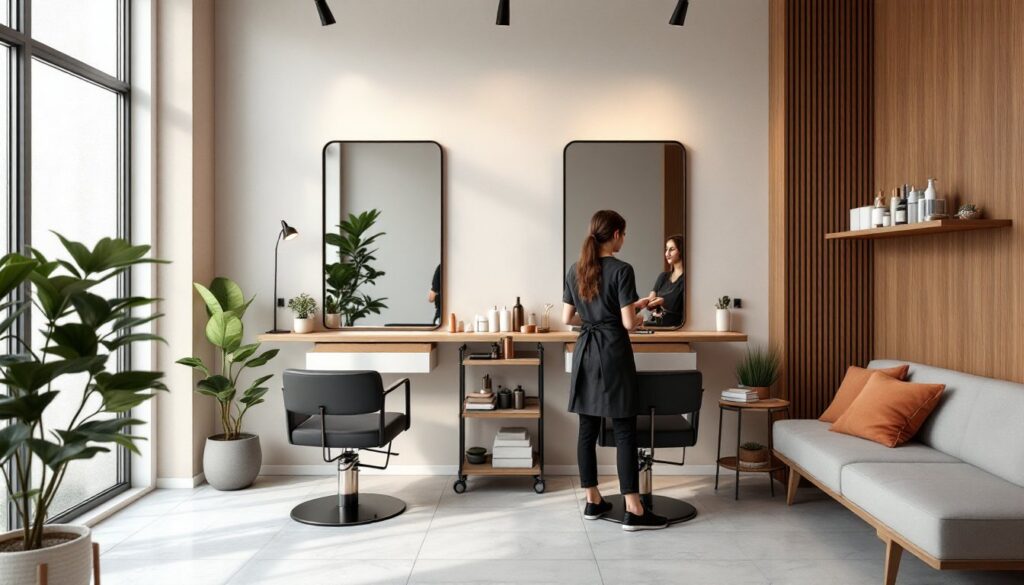
A typical styling station requires about 4 feet of width and 3 feet of depth when the chair is occupied. Shampoo bowls need roughly 3 feet by 5 feet, including technician standing room. If space is tight, consider wall-mounted stations rather than island configurations, they free up floor circulation and make the room feel less cramped.
Traffic flow is non-negotiable. Clients and staff shouldn’t have to squeeze past each other. Aim for a minimum 3-foot-wide main walkway. If that’s impossible, stagger appointment times to reduce congestion.
Flooring choice affects the room’s apparent size. Large-format tiles (12×24 inches or bigger) with minimal grout lines create fewer visual breaks than small mosaics, making the floor plane read as more expansive. Luxury vinyl plank (LVP) in a light wood tone also works well, it’s water-resistant, warm underfoot, and easier on the knees than ceramic during long shifts.
Check local building codes before finalizing the layout. Salons typically fall under commercial occupancy classifications, which may dictate minimum aisle widths, emergency egress, and plumbing fixture counts. If you’re leasing, confirm that your layout changes don’t require landlord approval or permits.
Color Schemes That Make Small Salons Feel Spacious
Light, neutral palettes are the default recommendation for a reason: they reflect more lumens and push walls visually outward. Soft whites, warm grays, and pale taupe are safe bets. But “light” doesn’t mean sterile. A monochromatic scheme in shades of greige or off-white adds depth without closing in the space.
If neutrals feel too bland, introduce a single accent wall in a deeper tone, charcoal, sage, or muted terracotta. Place it on the longest uninterrupted wall to draw the eye lengthwise and elongate the room. Avoid dark paint on all four walls: that amplifies the shoebox effect.
Sheen matters as much as hue. Satin or semi-gloss finishes bounce more light than flat paint, subtly brightening the space. They’re also easier to wipe down, critical in a salon environment where hairspray, color, and product residue accumulate.
Mirrors are the oldest trick in the book, but they work. Full-height mirrors behind each styling station double the perceived width. Frameless or minimally framed mirrors maintain a clean, modern look and don’t chop up the wall plane.
Many homeowners find that choosing cohesive palettes across rooms helps with flow, much like developing a detailed interior design proposal for residential projects. The same logic applies in commercial spaces, consistency reduces visual clutter.
Smart Storage Solutions for Compact Salon Spaces
Clutter kills the illusion of space. Every product, tool, and towel needs a designated spot, preferably out of sight.
Wall-mounted cabinets with doors keep styling tools, color tubes, and retail inventory concealed while freeing up floor area. Floating shelves work for display, think curated retail products or a few succulents, but open shelving for working stock creates visual noise.
Use vertical space aggressively. Install peg boards or slatwall panels behind stations to hang blow dryers, flat irons, and shears. Magnetic strips mounted on the side of a cabinet can hold metal tools and clips.
Rolling carts are a flexible alternative to fixed storage. A three-tier cart can hold color bowls, foils, and brushes, then tuck under a counter or into a corner when not in use. Look for carts with locking casters so they don’t drift mid-service.
Under-sink storage is often underutilized. Add pull-out drawers or stackable bins under shampoo bowls to organize towels, capes, and cleaning supplies. Make sure plumbing access remains code-compliant, most jurisdictions require unobstructed access to shut-off valves.
If you’re designing storage from scratch, consider custom millwork. A built-in bench with hinged-seat storage or a reception desk with integrated cubbies maximizes every inch. Sheet goods like 3/4-inch plywood work well for carcasses: finish with laminate or paint for easy cleaning.
Furniture and Station Selection for Small Salons
Scale is everything. Oversized salon chairs and bulky reception desks can overwhelm a small footprint. Measure carefully and choose pieces proportional to the room.
Look for styling chairs with a smaller base diameter, many manufacturers offer compact or “apartment-size” salon chairs that retain full hydraulic lift and tilt but sit on a 22-inch round base instead of the standard 26-inch. That saves 4 inches per station, which adds up fast.
Wall-mounted stations eliminate the need for floor-standing consoles. A floating shelf with a built-in power strip and a mirror-mounted tool holder delivers full functionality in about 18 inches of depth. This approach works especially well in narrow or galley-style layouts.
Reception desks don’t need to be monolithic. A slim console table (12 to 14 inches deep) paired with wall-mounted check-in software or a tablet stand can handle check-ins and checkouts without hogging square footage. Add a small stool underneath for the receptionist.
Shampoo bowls are tougher to miniaturize, but backwash units are generally more compact than sidewash bowls and allow the client to recline, which can feel more luxurious in a smaller setting. Some models mount directly to the wall, eliminating the cabinet base and saving floor space.
For waiting areas, skip the traditional sofa. A built-in bench along one wall with a few throw pillows provides seating without blocking sightlines or circulation. Pair it with a narrow console or floating shelf for magazines and a small plant.
Designers looking for creative approaches to compact layouts often explore strategies used in interior design rendering software to test furniture placement digitally before committing to purchases.
Lighting Strategies to Enhance Your Small Salon
Lighting is non-negotiable in a salon. Poor lighting leads to bad color jobs, uneven cuts, and client dissatisfaction. But it also shapes how large and inviting the space feels.
Layered lighting is the professional standard: ambient (general illumination), task (workstation-focused), and accent (highlighting features or retail).
For ambient lighting, recessed LED downlights with a color temperature around 4000K to 5000K mimic natural daylight without the harshness of cool white fluorescents. Space fixtures about 4 feet apart in a grid to avoid dark corners. Dimmer switches add flexibility for different times of day or services.
Task lighting at each station is critical. Wall-mounted swing-arm lamps or overhead track lights with adjustable heads let stylists direct light exactly where needed. Look for fixtures with a CRI (Color Rendering Index) above 90, this ensures accurate color perception, especially important for hair coloring.
Avoid placing task lights directly behind the stylist: it creates shadows on the client’s head. Position them slightly forward and to the side, or use a ring light mounted to the mirror for even, shadow-free illumination.
Accent lighting can highlight a retail display or an accent wall without adding clutter. LED strip lights tucked under floating shelves or behind mirrors add a soft glow that visually expands the space.
Sources like Homedit frequently cover how lighting transforms small interiors, and the principles translate directly to commercial salon design. Natural light is a bonus if you have windows, but tint or shade them to prevent UV damage to retail products and uneven color work.
Avoid chandeliers or oversized pendant lights in low-ceiling spaces. They drop the visual ceiling height and can interfere with tall clients or stylists. Flush-mount or semi-flush fixtures keep the ceiling plane open.
Creating an Inviting Atmosphere in Limited Square Footage
Atmosphere is the sum of sensory details: sight, sound, scent, and texture. A small salon can feel boutique and exclusive rather than cramped if the details are dialed in.
Sound control is often overlooked. Hard surfaces, tile, mirrors, glass, reflect noise and create a chaotic acoustic environment. Add soft materials where possible: upholstered seating, fabric window treatments, or acoustic ceiling tiles. If the ceiling is exposed (ductwork, pipes), consider a coat of matte black paint rather than acoustic panels, it recedes visually and absorbs some sound.
Scent sets the mood immediately. Avoid heavy synthetic fragrances: they can clash with hair products and trigger headaches. A subtle essential oil diffuser with eucalyptus, lavender, or citrus keeps the air fresh without overwhelming. Make sure the HVAC system is adequate, salons generate a lot of fumes and humidity, and poor ventilation makes a small space feel claustrophobic.
Texture and materials add warmth without bulk. A jute rug under the waiting bench, a wood accent wall, or linen curtains soften the hard-edged utility of salon equipment. Keep it minimal, one or two textural elements per zone.
Greenery brings life to tight spaces. A single large plant (a fiddle-leaf fig or a snake plant) in a corner draws the eye up and adds a pop of organic color. Avoid cluttering stations with tiny potted plants, they collect dust and product overspray.
Reception and checkout areas deserve attention. A small vase with fresh or faux flowers, a branded business card holder, and a simple “thank you” sign make the space feel curated. Design publications like MyDomaine often showcase how small finishing touches elevate interiors, and the same discipline applies here.
Consider adding a signature detail: a unique mirror frame, a vintage barber chair, or a hand-painted mural on the accent wall. It gives clients something to remember and photograph for social media, free marketing.
Those wanting to explore more small-space strategies can browse interior design tips that emphasize maximizing function and style. Communities like Apartment Therapy also provide countless examples of compact commercial and residential transformations worth studying.
Conclusion
Small salon design is about discipline: every choice must earn its place. Prioritize layout efficiency, choose light colors and smart storage, select appropriately scaled furniture, layer lighting for function and mood, and polish the atmosphere with texture and detail. Done right, a compact salon feels intentional, not limited, and clients will notice the difference.